Bridging the Physical-Digital Divide: 6 Ways to Strengthen Your Cyber Security Posture
You might have an enterprise-grade firewall and multi-layered encryption, but if an adversary physically walks up to your server rack, your digital defences are instantly rendered useless. The security industry has long operated under a clear reality: if an attacker gains physical access to your hardware, it is no longer your hardware.
Strengthening your cyber security posture requires looking beyond digital perimeters. Physical security gaps directly translate into cyber vulnerabilities. Criminal and malicious attacks account for 55% of all data breaches, an increase of almost 8% year-on-year according to IBM’s Cost of a Data Breach Report. Furthermore, IBM’s research demonstrates that 10% of malicious breaches trace back to physical security compromises. Decades-old threat vectors, such as sensitive data walking out the door on a thumb drive remain a persistent risk alongside modern cyber attacks.
Reviewing the intersection where physical security and cyber security overlap allows organisations to close critical vulnerabilities and build enterprise-wide resilience. Here are six actionable best-practice strategies to bridge the physical-digital divide and reinforce your overall security posture.
1. Enforce Rigorous Password Hygiene and Authentication
Stolen or compromised credentials account for 14% of initial breach vectors, while easily guessable passwords trigger 21% of security incidents. Relying on memory or manual tracking invites dangerous shortcuts. Consider the following password hygiene tips:
- Deploy Enterprise Password Managers: Use centrally managed tools to sync encrypted credentials across teams without exposing plain text passwords.
- Eliminate Written Credentials: Ban physical notes or post-it stickers near workstations.
- Enforce Multi-Factor Authentication (MFA): Require secondary verification for all network and physical access points.
- Optimise Passphrase Length: Prioritise length over complex character rules. Aim for 16-plus characters combining random words, numbers, and symbols, avoiding predictable details like company names or dates.
2. Lock Down Physical USB and Expansion Ports
Removable media represents a persistent physical bridge into isolated networks and are behind 10% of threat vectors, according to IBM. Malicious thumb drives, hardware-level "BadUSB" controller hacks, and compromised charging ports easily bypass perimeter firewalls to deploy hidden malware or extract critical files.
Securing physical access to endpoints requires a layered approach:
- Install physical port locks on exposed hardware in accessible areas.
- Apply administrative blocks via Windows Device Manager or Registry settings to restrict the use of unauthorised mass storage devices.
- Disable unused USB controllers directly at the BIOS/UEFI level on high-risk computer terminals.
3. Build Employee Vigilance Through Continuous Training
Phishing remains the top vector for initial network penetration year after year. Technical controls must be paired with operational awareness to protect against social engineering and physical tailgating.
Organisations should run regular security awareness programs and unannounced phishing simulations. Complement this training with clear, tested incident response plans so staff can immediately flag, contain, and report suspicious physical or digital activity. Continual risk assessments will help identify emerging gaps across your estate.
4. Maintain Systematic Patching and Endpoint Defences
Unpatched software exposes known vulnerabilities that attackers actively exploit. Operating systems, firmware, and connected devices need quick, routine updates to maintain defensive integrity.
Pair active patching with encrypted, isolated backups of critical assets, regularly testing your restoration workflows. Active endpoint protection tools must be maintained across all connected hardware, from server arrays to field devices, to detect anomalies before they escalate.
5. Counter Insider Threats via Physical Identity & Access Management
Disorganised access rights create blind spots that malicious insiders or compromised personnel can exploit. Mitigating insider threat requires real-time correlation between physical presence and digital activity.
Integrated systems, such as ISM’s CAPSS-approved Genesys platform, use advanced Command & Control (C2/C3I) logic alongside Physical Identity & Access Management (PIAM). By cross-referencing an employee's physical location against their network activity, the platform actively flags anomalies, such as an operator attempting a late-night system login when their physical badge shows they haven't entered the building.
6. Converge Infrastructure into an Intelligent Converged Management System (ICMS)
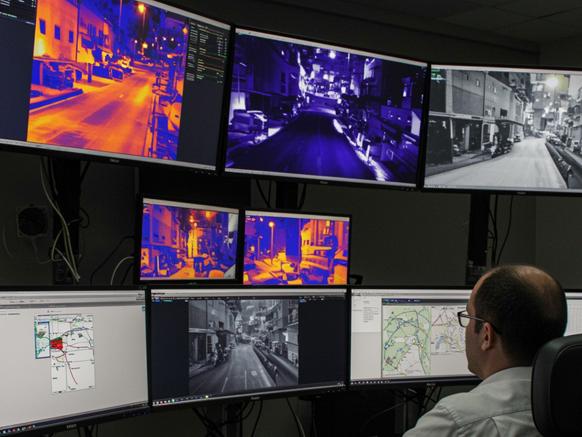
Siloed IT, Facilities, and physical security platforms cause dangerous operator fatigue. When control room staff are overwhelmed by disparate screens and uncoordinated alerts, response times drop and critical risks get missed.
Moving to an Intelligent Converged Management Solution (ICMS) like Genesys elevates overall resilience. Our platform combines alerts from a range of different sensors and security systems into a single pane of glass, allowing for automation workflows that give security control room operators greater visibility without extra overheads.
Unifying physical and digital security data gives your team total situational awareness, ensuring your cyber security posture is backed by robust physical defence.
| Operational Challenge | Intelligent Converged Management Solution Benefits |
| Data Overload & Silos | Consolidates disparate inputs i.e. (IDS, access control, PIDs, radar, videosystems etc.,) into one unified interface. |
| Delayed Emergency Response | Enables automated incident workflows, such as rapid INVAC (Invacuation) lockdown & EXVAC (Exvacuation) procedures during emergency incidents. |
| Complex Forensic Audits | Allows operators to run fast forensic searches across vast, multi-site estates from a single console. Maintaining secure authorisation levels when accessing sensitive and critical content. |
Upgrade Your Cyber-Physical Security
Is your legacy infrastructure exposing your business to cyber-physical risks? Contact ISM today for a tailored consultation on unifying your security ecosystem through our CAPSS-approved Genesis ICMS platform.